
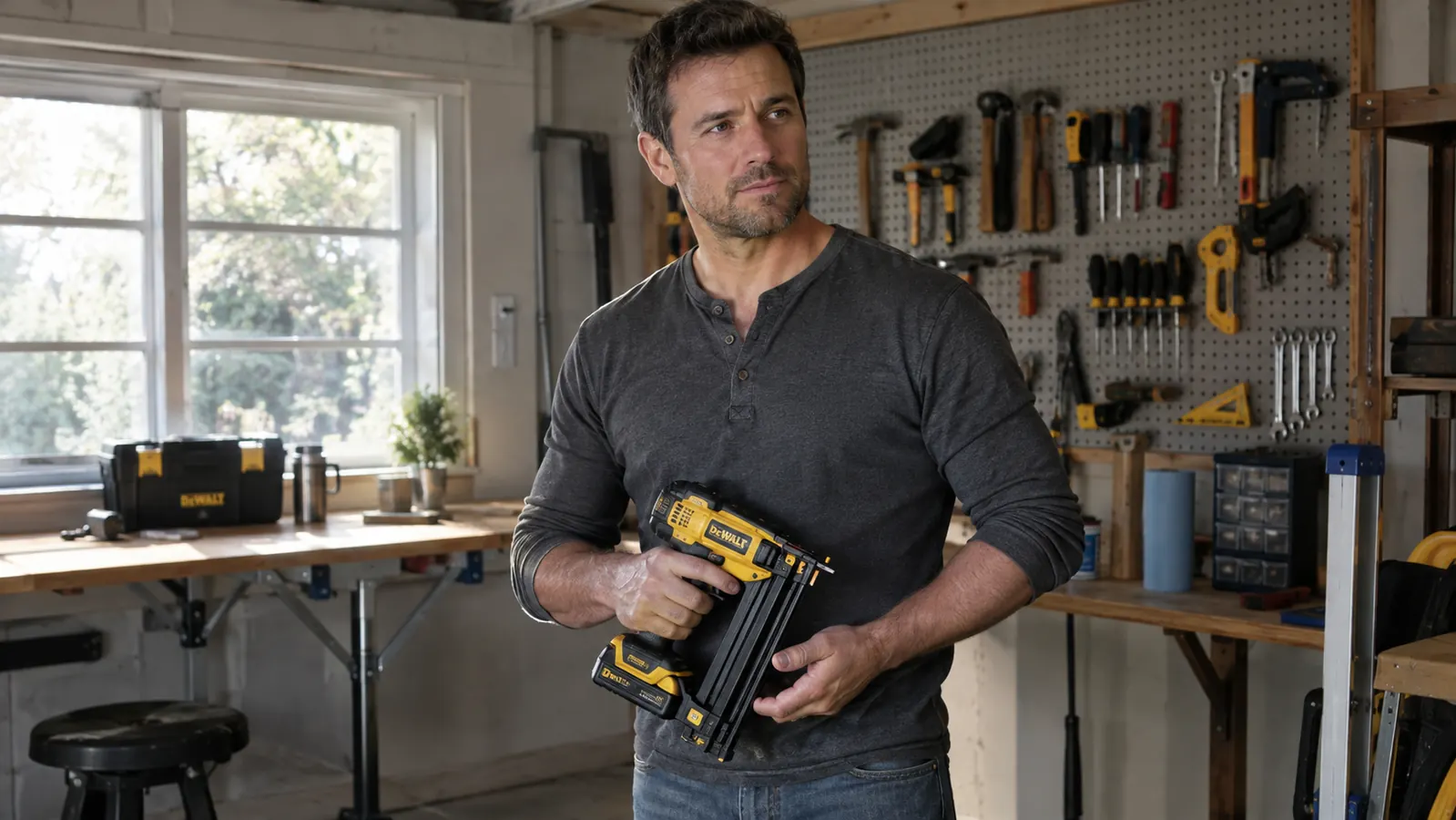
I have a confession to make. I bought the Craftsman V20 brad nailer for one job, a hallway of shoe molding, and then spent the next year finding excuses to use it. That is the honest version of this review. The shorter version, the one you see in the product listing, is that it is a cordless 18 gauge nailer with a battery and charger included. What the listing does not tell you is how it behaves on the third hour of trim work, how it handles a hard maple threshold, or what it feels like when the battery is at 20 percent and you are on your knees in a hallway. I have used this nailer on baseboards, window casing, door casing, shoe molding, and a set of floating shelves. I have also loaned it to my husband, who managed to jam it twice in one afternoon. So this is the review I wish someone had written for me before I bought it.
The Quick Verdict
The Craftsman V20 brad nailer is the tool I reach for first on almost every trim job, but it is not the tool I reach for on every trim job. It sinks 18 gauge brads cleanly into pine, poplar, and MDF, it is genuinely portable, and the battery life is better than I expected. It also jams more often than a pneumatic nailer, it will not sink a brad into hard maple without a fight, and the depth adjustment wheel is fiddly enough that I have learned to set it before I start, not while I am working.
Amazon Check Today's Price →The cordless brad nailer I keep reaching for
After a year of trim work, this is the nailer that lives on my work table. It sinks 18 gauge brads into the materials I actually use, the battery lasts through a full afternoon of casing, and it goes wherever I go. If you are tired of dragging an air compressor around the house, this is worth a look.
Amazon Check Today's Price on Amazon →How I Have Used It
I am Marlo Kessinger. I have spent the last 14 years remodeling my own 1962 ranch house in Fresno, one room at a time on weekends. My workshop is a one-car garage with a folding work table, a sawhorse setup, and a pegboard wall. I do not have a stationary air compressor plumbed into the wall, and I do not have room for one. That is the context for this review. If you already own a compressor and a pneumatic brad nailer, this tool is a different category of purchase. If you are like me, working in a garage that doubles as a parking spot, the cordless argument is the whole argument.
I bought the Craftsman V20 in the spring, and in the first month I used it to install all the casing in my second bathroom remodel. That was roughly 40 feet of poplar casing, maybe 200 brads, plus the shoe molding in the same room. The battery that came in the box handled the entire job and still showed a charge. Since then I have used it on baseboard in the living room, window casing in the front bedroom, a set of floating shelves in the hallway, and a repair job on a kitchen cabinet door where I needed to shoot brads into particle board without splitting it. That last job is where the tool surprised me. The narrow crown and the adjustable depth let me set brads just below the surface of particle board, which is harder to do cleanly than it sounds.
The honest part of this review starts here. I have also had this nailer jam on me. The first jam happened on a humid afternoon in July, shooting into a piece of pine that had a slight twist. The second jam was my husband's doing, when he tried to fire brads too fast into a piece of MDF and the magazine skipped. Both jams cleared in under a minute with the tool's jam release, which is a real feature and not a marketing word. But a pneumatic nailer I used years ago jammed maybe once in three years. This one has jammed twice in twelve months. That is the tradeoff you are signing up for when you give up the hose.
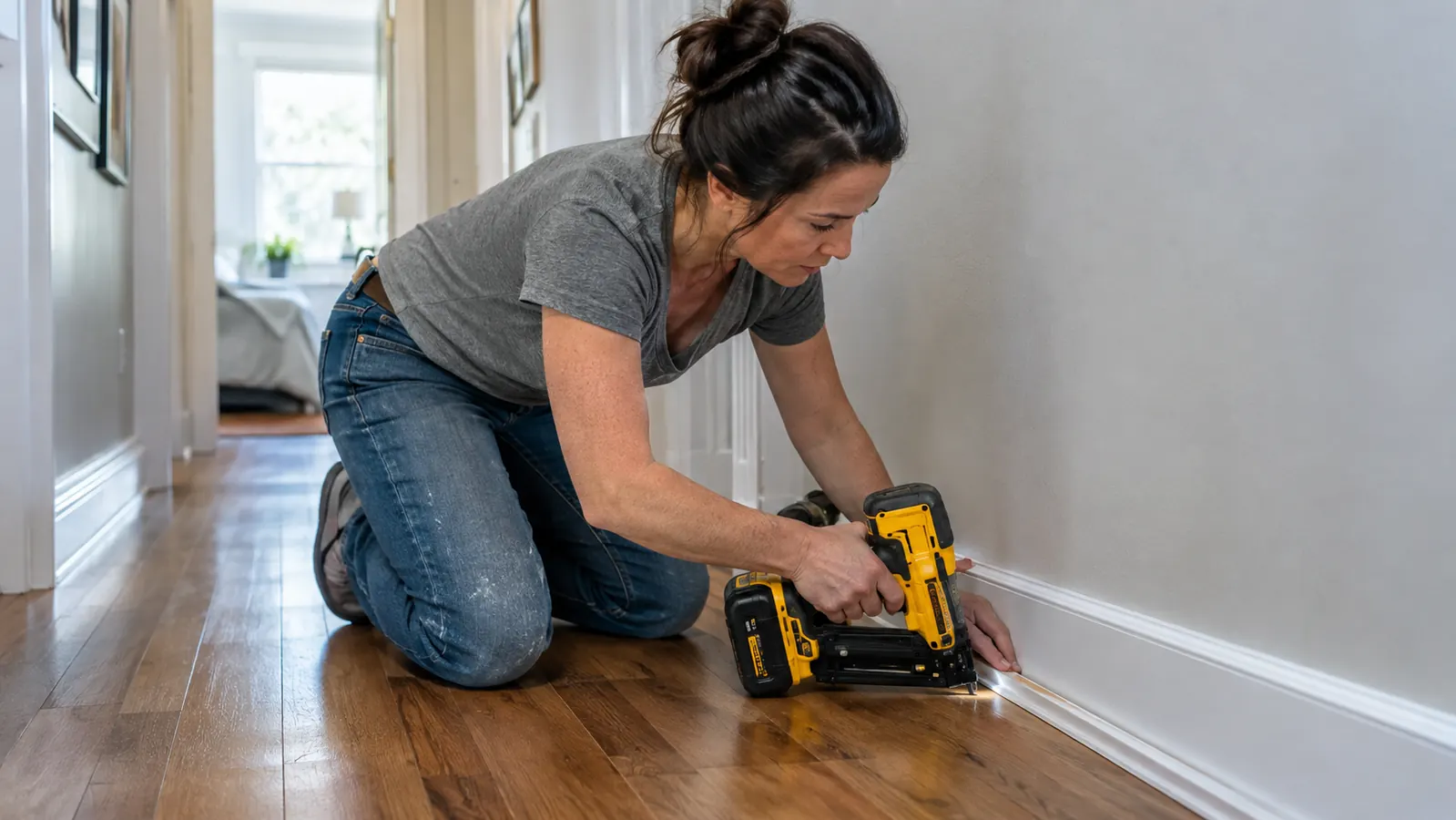
The first real job I gave the CRAFTSMAN V20 was the hallway in our 1962 ranch, which runs about 22 feet from the living room to the back bedrooms and has four door openings along it. That meant a lot of short baseboard runs, a lot of inside corners, and casing around every door. The old trim had been painted so many times that the profiles were soft, so I pulled all of it and started over with primed MDF. Over two Saturdays I put up roughly 90 linear feet of baseboard and four sets of casing, and I never once had to drag a hose down the hall or listen to a compressor kick on while my husband was on a phone call.
The thing I noticed right away was how much easier it is to work alone with a cordless nailer. With a pneumatic setup I always ended up holding the trim with one knee, the gun in one hand, and the hose in the other, trying not to knock a picture off the wall. With the CRAFTSMAN I could hold a long piece of baseboard tight to the wall with my left hand and fire with my right. That alone made me willing to tackle the closets, which I had been putting off for years.
What Nobody Tells You About the Depth Adjustment
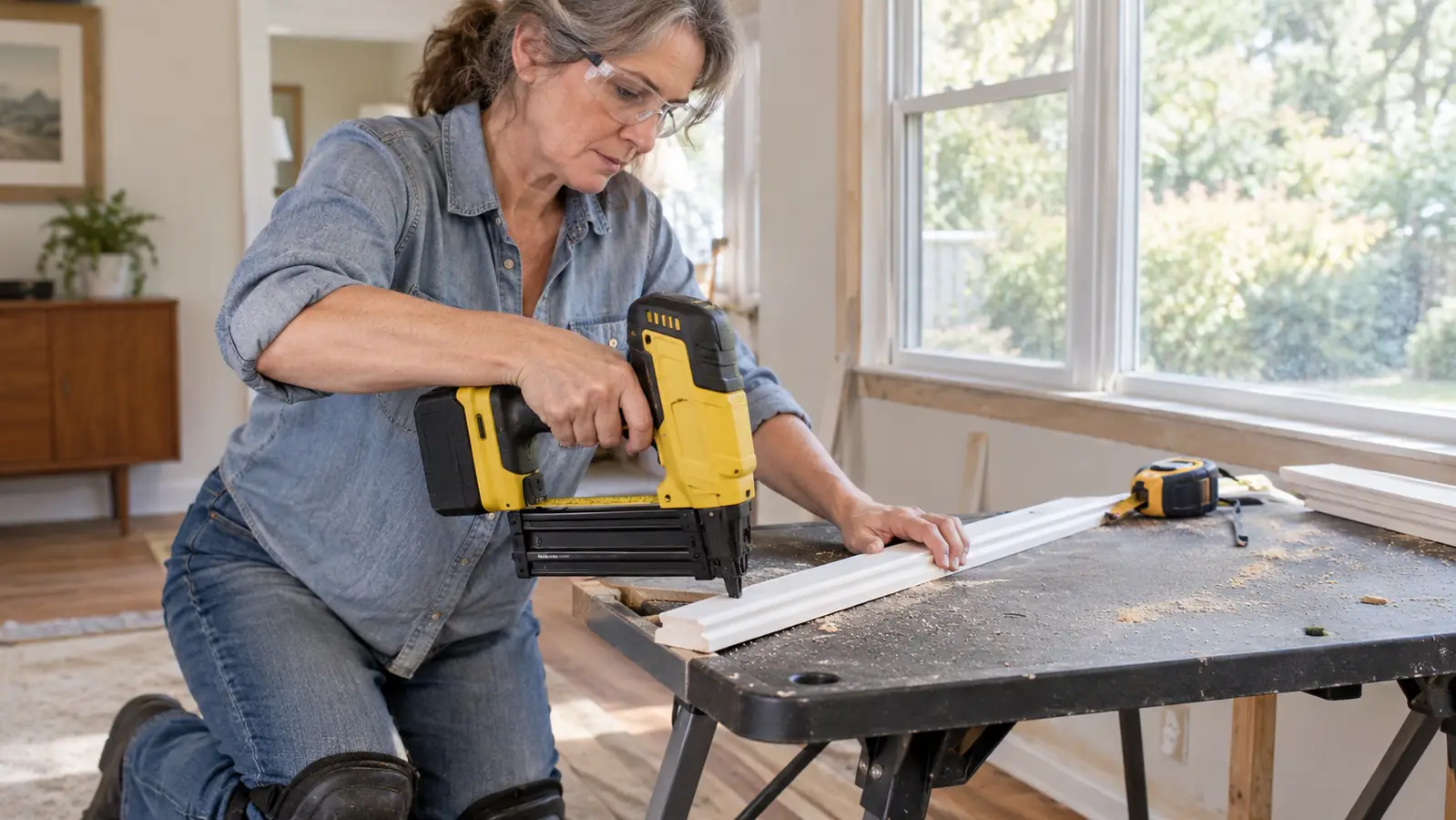
The depth adjustment wheel on the Craftsman V20 is the thing I did not understand until I had used the tool for a month. It is a small wheel near the nose, and it changes how deep the brad sits below the surface of the wood. The manual explains it. The product photos show it. What nobody tells you is that you will set it, fire a test brad, and then set it again, and then again, because the difference between a brad that sits flush and a brad that sinks too deep is a quarter turn of that wheel. On poplar and pine, I have learned to start with the wheel in the middle and adjust from there. On MDF, I turn it shallower. On hard maple, I turn it deeper and accept that some brads will not sink all the way.
The other thing nobody tells you is that the depth setting drifts. Not much, and not every time, but enough that I have learned to check it at the start of every session. I keep a scrap of poplar on my work table and I fire one test brad into it before I start on the real piece. That habit has saved me more than once. If you are the kind of person who reads the manual once and then never looks at it again, this is the one adjustment on this tool that deserves your attention.
The difference between a brad that sits flush and a brad that sinks too deep is a quarter turn of that wheel.
Battery Life and the Included Battery
The Craftsman V20 comes with a battery and charger in the box, which is the main reason I chose it over a bare tool from another brand. I already own a few Craftsman V20 tools, so the battery system made sense for my garage. The included 2 amp hour battery has driven roughly 1,500 brads across the year I have owned it, and I have never run it dead in a single session. The longest single session was a Saturday when I installed baseboard in the living room, about 60 linear feet, and the battery still had charge left when I stopped for lunch.
What I will tell you honestly is that the tool does not feel as strong at the end of a battery charge as it does at the start. The first 50 brads out of a fresh battery sink with authority. The last 20 before the low battery light comes on sink with noticeably less force. On soft pine you will not notice. On oak or maple you will, and you will find yourself swapping batteries before the light even comes on. I keep a second battery on the charger, which is the real answer to this complaint. If you are buying this as your first cordless tool and you do not have a spare V20 battery, budget for one.
One habit that saved me a lot of grief: I keep a short scrap of the actual trim I am installing next to me and fire one test nail into it every time I change materials. MDF baseboard, pine shoe molding and oak stop molding all want a slightly different depth setting, and the dial on the CRAFTSMAN is easy to bump when you set the tool down. Ten seconds of testing is a lot cheaper than filling a dozen nail heads that sit proud, or worse, a dozen that blew a crater in the face of a painted piece.
Where the Craftsman V20 Falls Short
I want to be direct about the things this nailer does not do well, because the product listing will not tell you. The first is hardwoods. I installed a white oak threshold in the hallway and the Craftsman V20 struggled to sink 18 gauge brads flush. I ended up setting most of those brads with a hammer and a nail set, which is exactly the kind of work I bought a nailer to avoid. The tool is fine for softwoods, MDF, and plywood. It is not a hardwood nailer, and no amount of depth adjustment changes that.
The second shortcoming is the jam rate. Two jams in a year is not a disaster, but it is more than I experienced with the pneumatic nailer I used in a friend's shop. Both of my jams happened when I was working fast, and both cleared quickly, but a jam in the middle of a glue-up is the kind of interruption that makes you question the tool. The third shortcoming is the size. This is not a heavy tool, but it is nose-heavy, and after a full afternoon of overhead work, like nailing up crown molding or working on the underside of a cabinet, my wrist notices. For baseboard and casing, which is most of what I do, it is fine. For overhead work, I would rather have a lighter tool.
The fourth thing I will mention is the dry fire lockout. The tool will not fire when the magazine is empty, which sounds like a feature and mostly is. But it also means the last brad in the magazine sometimes does not seat properly, and the tool refuses to fire even though there is a brad in there. The fix is to open the magazine and push the brad strip forward. It takes five seconds, but it is the kind of thing that makes you say words you would not say in front of your mother.
What I Liked
- Battery and charger included, so the box is the whole kit
- Genuinely portable, no compressor, no hose, no noise
- Sinks 18 gauge brads cleanly into pine, poplar, MDF, and plywood
- Jam release works as advertised, both jams cleared in under a minute
- Battery life is better than I expected, a full afternoon of casing on one charge
- Dry fire lockout protects the work surface from empty magazine surprises
Where It Falls Short
- Struggles with hardwoods like oak and maple, brads often need a nail set
- Jams more often than a pneumatic nailer, two in my first year
- Depth adjustment wheel drifts and needs checking at the start of each session
- Nose-heavy balance makes long overhead work tiring
- Last brad in the magazine sometimes fails to seat, causing a false dry fire
I also want to be fair about the weight. With the battery on, the CRAFTSMAN is noticeably heavier than a small pneumatic brad nailer, and after an afternoon of nailing crown-style trim above my head my shoulder knew about it. For baseboard, casing and shoe molding, which is most of what a homeowner nails, I never minded. If your project is mostly overhead work, take breaks and keep the tool resting on a step stool instead of hanging from your hand between pieces.
The other honest note is about jams. So far I have had exactly two, both when I was nailing near the end of a strip and a brad came out at an angle. Clearing them took less than a minute with the battery pulled, which is the only way I will clear any nailer. That is a better record than the cheap pneumatic gun I used years ago, but it is not zero, so keep the manual handy the first time it happens.
Who This Is For
This nailer is for the homeowner who does trim work a few weekends a year and does not own an air compressor. It is for the person who is tired of borrowing a pneumatic nailer from a friend and dealing with the hose. It is for the DIYer who works in a garage that has to fit a car back in at the end of the day. If that sounds like you, the Craftsman V20 brad nailer will probably be the best tool purchase you make this year. It is also for anyone who already owns Craftsman V20 batteries, because the bare tool version makes even more sense when you are not paying for the battery and charger.
Who Should Skip It
Skip this nailer if you do trim work every week, if you install hardwood flooring or trim on a regular basis, or if you already own a pneumatic setup that works. A cordless nailer is a convenience, not a performance upgrade. The Craftsman V20 will not replace a pneumatic nailer for production work, and it will not sink brads into oak the way a pneumatic will. If your work is mostly hardwoods, or if you need to shoot hundreds of brads a day, save your money and buy a compressor and a pneumatic nailer. You will be happier in the long run.
Still the one I grab first
For my kind of work, weekend trim projects in a house that is never quite done, the Craftsman V20 brad nailer is the right tool. It has limits, and I have told you exactly what they are. If those limits do not scare you off, this is a nailer you will use for years.
Amazon Check Today's Price on Amazon →