
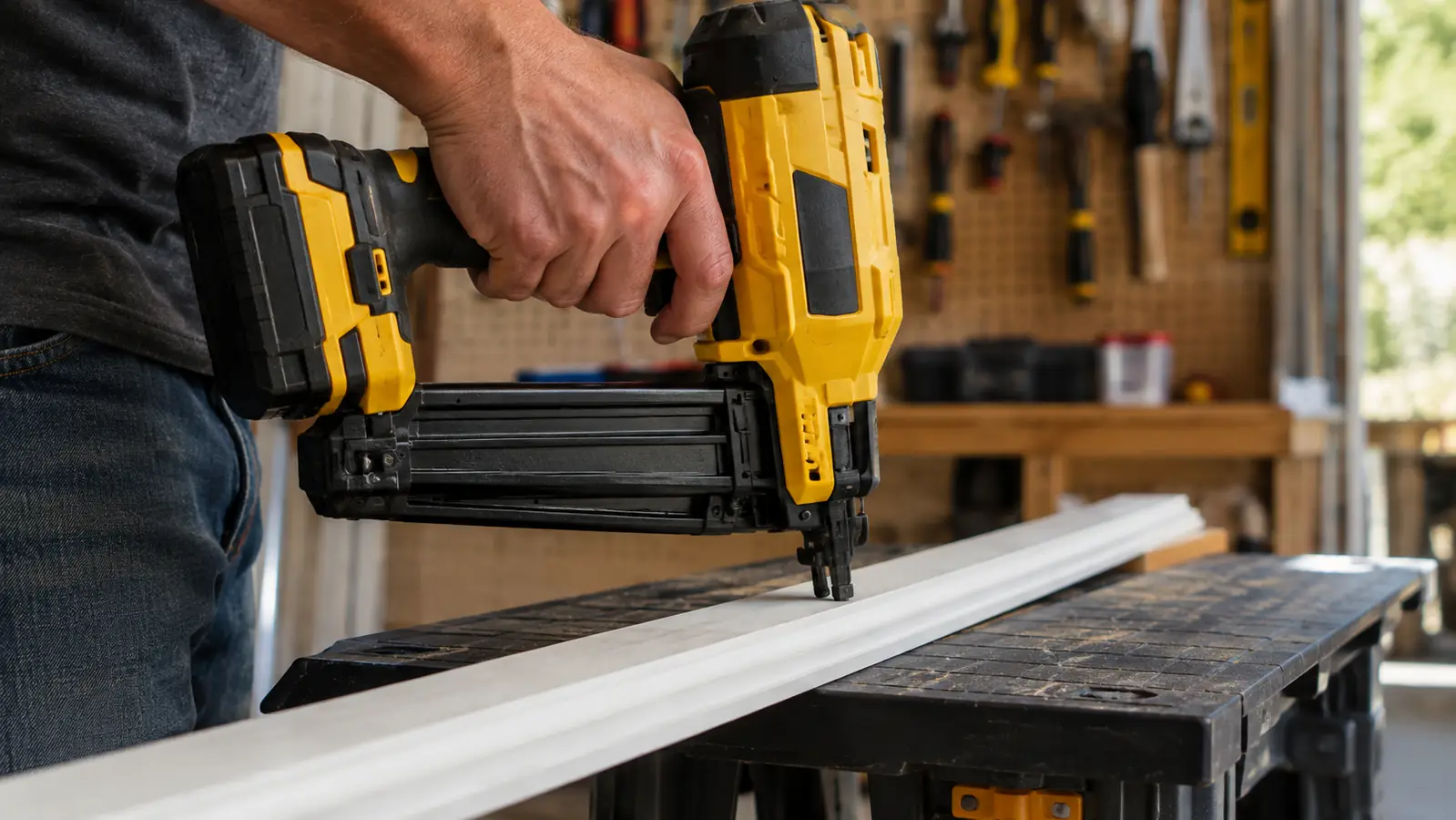
The first time I used the Craftsman V20 brad nailer, I was standing in my hallway with a piece of door casing in one hand and a hammer in the other, wondering why I kept doing things the hard way. I had already redone the kitchen and both bathrooms in my 1962 ranch, and every single piece of trim in those rooms had been nailed by hand. My thumb had the bruises to prove it. So when I finally picked up the Craftsman V20 cordless brad nailer, I expected a small convenience. What I got was a tool that changed how I think about trim work entirely.
This is not a tool review written after a weekend of light use. I have had the Craftsman V20 brad nailer in my converted one-car garage workshop for over a year. It has hung baseboards in my living room, door casings in both bathrooms, window trim in the bedroom, and a whole lot of shoe molding in between. It has also sat in a drawer for two months, been dropped onto a concrete floor, and survived a Fresno summer in an uninsulated garage. Here is what that year actually looked like.
The Quick Verdict
The Craftsman V20 brad nailer is the tool I reach for first on any trim job. It drives 18-gauge brads deep enough for solid wood, the depth adjustment actually works, and the battery life is genuinely impressive. It is not the most powerful nailer I have used, and the magazine can be finicky with the last few brads, but for a DIY homeowner doing real remodeling, it is the right balance of price, performance, and convenience.
Amazon Check Today's Price →Stop hand-nailing your trim. This is the nailer I reach for first.
The Craftsman V20 brad nailer has been my go-to for over a year of real remodeling. It drives brads deep, runs on a battery I already own, and has saved me hours on every trim job since.
Amazon Check Today's Price on Amazon →How I've Used It
My house is a 1962 single-story ranch, about 1,600 square feet, and I bought it as a dated fixer. Over the last 14 years I have redone the kitchen, both bathrooms, the floors in the living areas, and the trim throughout, one room at a time on weekends. My workshop is a one-car garage with a folding work table, a sawhorse setup, and a pegboard wall. No big stationary tools. Everything I own has to earn its place in that space.
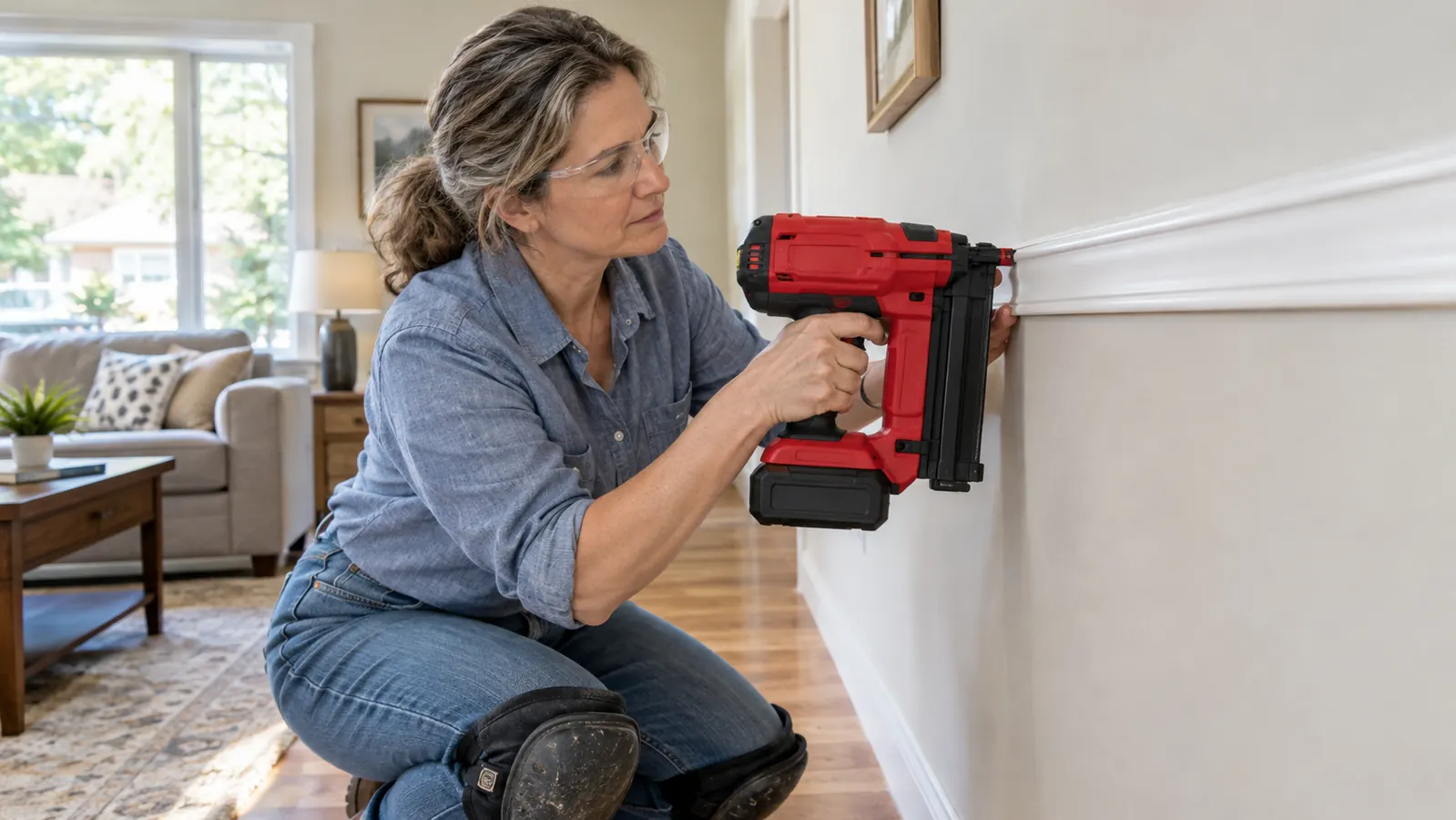
The Craftsman V20 brad nailer earned its place in about an afternoon. My first real project with it was the living room baseboards, roughly 60 linear feet of primed MDF. I set the depth adjustment to about halfway, loaded a strip of 2-inch 18-gauge brads, and started at the far corner. The first few nails went in perfectly flush. By the time I reached the other end of the room, I had stopped checking every single nail and started trusting the tool. That is the moment a tool becomes useful: when you stop thinking about the tool and start thinking about the work.
Since then, the Craftsman V20 has hung door casings in both bathrooms, window trim in the bedroom, a chair rail in the dining area, and countless pieces of shoe molding. It has also been used for less glamorous jobs: tacking up a temporary shelf, holding a piece of plywood in place while I measured, and once, securing a loose piece of siding until I could get to a proper repair. It is the tool I grab when I need a nail in something and I do not want to drag out a compressor.
Most of my use has been baseboard and door casing, but the job that convinced me was the linen closet. It is a narrow space, about 30 inches wide, and I added three shelves on cleats plus a small piece of decorative trim along the front edge of each shelf. Working inside a closet with a hose is miserable. With the CRAFTSMAN V20 I could sit on a step stool, hold each cleat against a pencil line, and tack it in place before driving screws. The brads held the cleats exactly where I wanted them while the screws went in, which is a small thing that makes a closet shelf come out level instead of almost level.
What the Craftsman V20 Gets Right
The first thing you notice about the Craftsman V20 brad nailer is the lack of a hose. I know that sounds obvious, but it is the difference between a tool you use and a tool you avoid. With a pneumatic nailer, every job starts with dragging the compressor out of the garage, uncoiling the hose, and making sure you have enough reach. With the Craftsman V20, you grab the nailer, check the battery, and go. For someone like me who works in short bursts between other responsibilities, that convenience is the whole ballgame.
The depth adjustment is the feature I did not expect to care about as much as I do. It is a dial on the front of the tool, and it actually works. On soft MDF, I set it shallow so the brads sit just below the surface. On hard oak, I set it deeper so the head sinks enough to fill. The difference between a professional-looking trim job and a DIY-looking one is often just this: whether the nail heads are consistently set. The Craftsman V20 makes that consistency easy.
Battery life has been a pleasant surprise. The Craftsman V20 uses the same V20 battery platform as the rest of my Craftsman tools, so I always have a charged battery ready. A single 2Ah battery will drive several hundred brads, which is more than enough for any weekend project. I have never been mid-project and had the nailer die on me. That is the kind of reliability that makes you trust a tool.
After many months, the battery is the part I think about most. I use the one that came in the kit and keep it on the charger between sessions. On a full charge I have nailed an entire bedroom of baseboard and casing, with plenty left over. The battery has not noticeably faded yet, and the tool still fires as consistently as the day I opened the box. If you already own other V20 tools, the batteries swap over, which is a quiet bonus for anyone building a small set of cordless tools one project at a time.
Where It Falls Short
The Craftsman V20 brad nailer is not perfect, and I would not trust anyone who says otherwise. The most consistent annoyance is the magazine. Loading a fresh strip of brads is easy, but the last two or three brads in a strip sometimes fail to feed properly. You will be cruising along, the nailer will make a clicking sound instead of driving a nail, and you will have to open the magazine, jiggle the strip, and close it again. It is a minor interruption, but it happens often enough that I have learned to expect it.
The second limitation is power. The Craftsman V20 is a brad nailer, not a finish nailer, and it is not designed for dense hardwoods or thick stock. It handles 18-gauge brads up to 2 inches long, which is perfect for trim, shoe molding, and light furniture work. But if you try to drive a brad into red oak or a piece of dense maple, you will sometimes get a nail that does not seat fully. I have learned to pre-drill or use a pneumatic nailer for those situations. It is not a flaw so much as a boundary, but it is worth knowing before you buy.
The third thing is the dry-fire lockout. The Craftsman V20 will not fire when the magazine is empty, which is a safety feature I appreciate. But it also means the last brad in a strip sometimes does not drive fully because the tool thinks it is empty. You will pull the trigger, hear a click, and find a brad sticking halfway out of your trim. It is a small thing, but it happens at the worst moments, usually when you are reaching for the last nail of a long run.
What I Liked
- No hose or compressor to drag out, so I actually use it for small jobs
- Depth adjustment dial is consistent once set for a material
- Battery life is genuinely impressive, several hundred brads per charge
- Quiet enough to use while someone else is in the house
- Light enough for overhead work like window casings without arm fatigue
Where It Falls Short
- Last two or three brads in a strip sometimes fail to feed
- Occasional dry-fire lockout leaves a brad sticking halfway out
- Not enough power for dense hardwoods like red oak or maple
- Magazine needs a jiggle to clear a misfeed mid-run
The depth adjustment on the Craftsman V20 is the difference between a trim job that looks professional and one that looks like a DIY project. I set it once per material and it stays consistent for the whole room.
One more thing the CRAFTSMAN gets right is the nose. It is narrow enough that I can see where the brad is going to land, which matters on thin shoe molding where a nail placed a quarter inch too high splits the piece. The tool also has a no-mar tip, and on painted trim I have not had it leave dents, as long as I press it squarely instead of at an angle. These are small details, but they are the difference between trim that needs ten minutes of touch-up and trim that needs an hour.
How It Compares to a Pneumatic Nailer
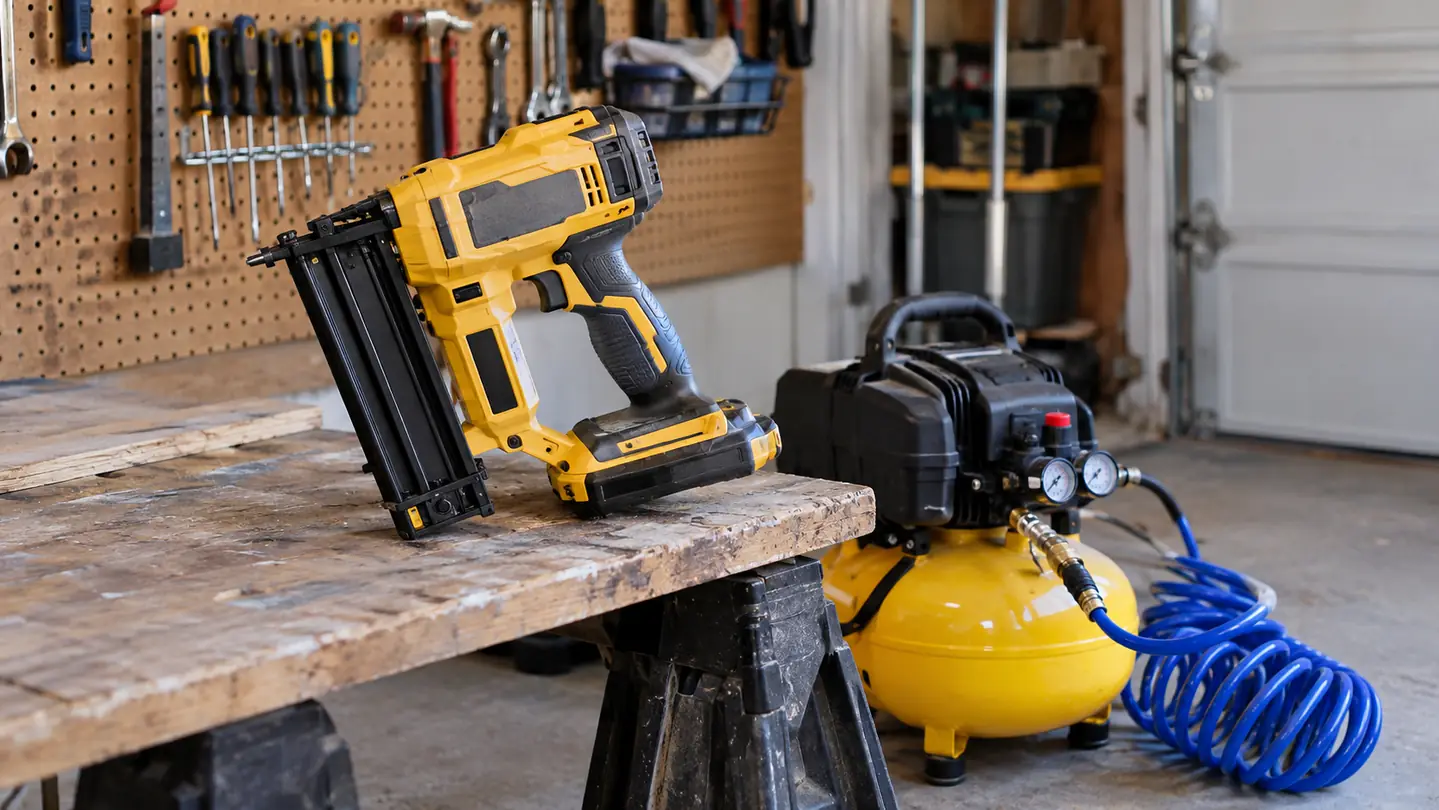
I still own a pneumatic brad nailer, and I use it for specific jobs. When I am working with dense hardwood or need to drive a lot of nails in a short time, the pneumatic is faster and more powerful. It also never runs out of battery, which is a real consideration on a long day of trim work.
But for the way I actually work, the Craftsman V20 wins almost every time. I do most of my remodeling in two-hour chunks on weekends. By the time I would have dragged the compressor out of the garage, uncoiled the hose, and checked the fittings, I could have already hung half a room of baseboards with the Craftsman V20. The convenience of picking up a tool and using it immediately is worth more to me than the raw power of a pneumatic system.
There is also the noise factor. A pneumatic nailer is loud, and the compressor is louder. The Craftsman V20 is noticeably quieter, which matters when you are working in a house with other people in it. My husband does not help much with the actual work, but he does appreciate not having to shout over the compressor.
Who This Is For
The Craftsman V20 brad nailer is for the DIY homeowner who is tired of hand-nailing trim. If you are remodeling your own house, room by room, and you want results that look professional without the hassle of a compressor, this is the tool for you. It is also a great choice if you already own other Craftsman V20 tools, because the batteries are interchangeable and you will never have to worry about a dead battery mid-project.
It is also for the person who does not have a dedicated workshop. The Craftsman V20 takes up almost no space, stores easily in a drawer or on a shelf, and is ready to go the moment you need it. For someone like me, with a one-car garage that doubles as a workshop, that is a real advantage.
Who Should Skip It
If you are a professional trim carpenter who drives thousands of nails a week, the Craftsman V20 is probably not the right tool for you. The magazine quirk and the occasional misfeed will cost you time on a job site, and a pneumatic nailer will be faster and more reliable over a full day of work.
You should also skip it if you regularly work with dense hardwoods like red oak or maple. The Craftsman V20 is designed for trim, molding, and light furniture work, and it will struggle with materials that need more driving force. For those jobs, a pneumatic finish nailer or a cordless finish nailer with more power is a better choice.
Finally, if you are looking for a tool that can do everything, this is not it. The Craftsman V20 is a brad nailer, and it does one job very well. If you need to drive larger finish nails or work with thicker stock, you will want a separate finish nailer. That is not a criticism of the Craftsman V20, just a reminder that every tool has its lane.
Ready to stop hand-nailing your trim?
The Craftsman V20 brad nailer has been my go-to for over a year of real remodeling. It drives brads deep, runs on a battery I already own, and has saved me hours on every trim job since.
Amazon Check Today's Price on Amazon →