

If you are remodeling a 1962 ranch one room at a time like I am, you eventually reach the same crossroads: do you buy the cordless oscillating tool everyone talks about, or do you save the money and plug in a corded multi-tool? I have spent the last 14 years trimming out my own house, and I have owned both. The short answer is that the DEWALT 20V MAX XR oscillating tool is worth it for most DIY homeowners, but not for the reason you might think. It is not about raw power. It is about having the tool ready when you are, without untangling a cord or hunting for an outlet.
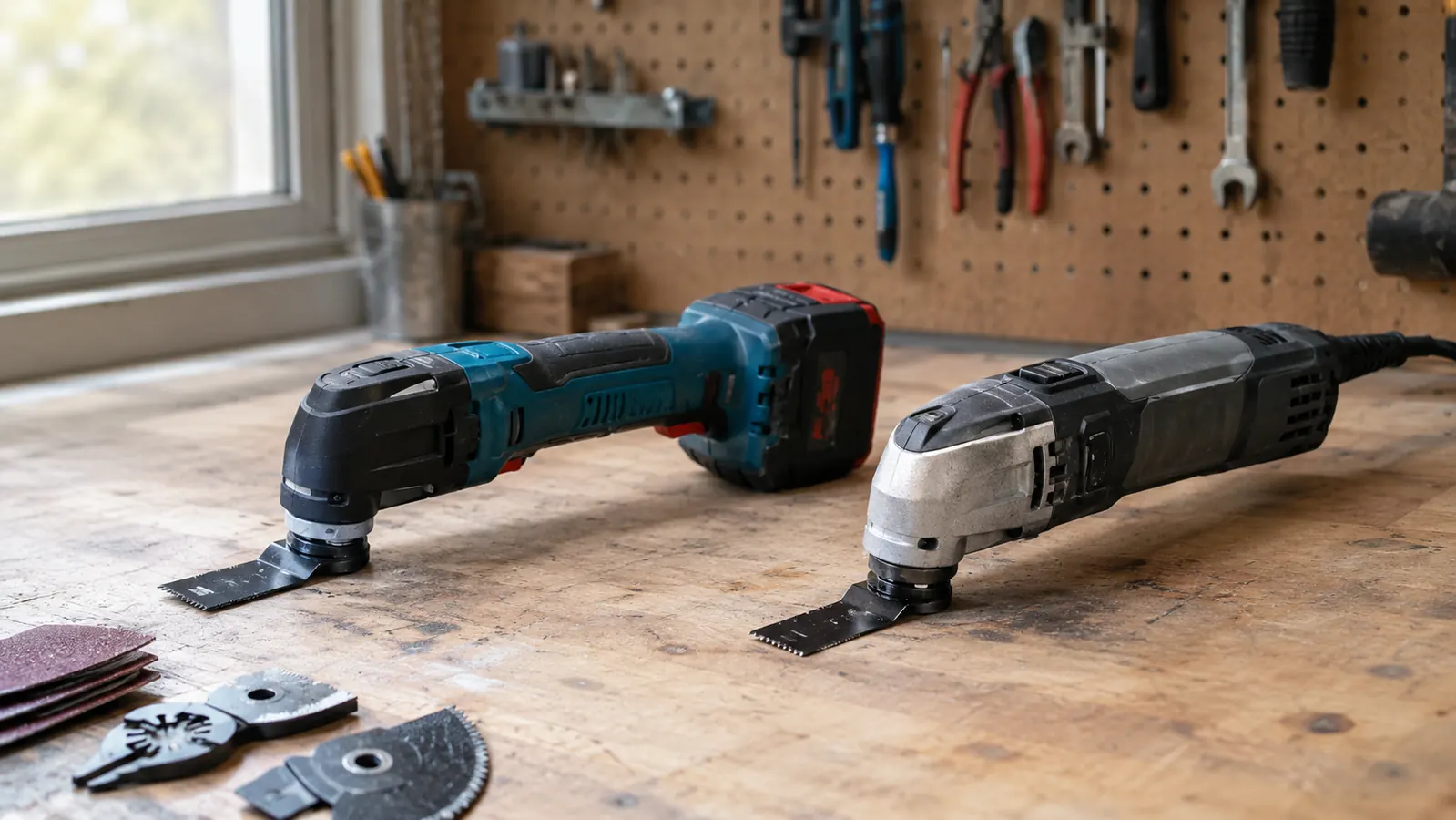
I tested the DEWALT DCS356 against a corded multi-tool in my garage workshop and around the house for several weeks. I cut door jambs, trimmed baseboard, sanded a patch of drywall, and cut a PVC pipe under the kitchen sink. Here is the honest comparison.
| DEWALT DCS356 | Corded Multi-Tool | |
|---|---|---|
| Power | Brushless motor with 3 speeds, plenty for trim, drywall, and PVC | Constant full power from the wall, slightly stronger on dense hardwood |
| Runtime | Runs on a 20V MAX battery, about 20 minutes of steady cutting per charge | Runs as long as the outlet is live, no battery to swap |
| Portability | No cord, easy to carry up a ladder or under a sink | Cord limits reach and tangles around sawhorses |
| Setup | Grab the tool, slide in a battery, go | Find an extension cord, plug in, manage the cord while you work |
| Blade change | Tool-free lever, quick and easy | Tool-free on most models, but some need an Allen wrench |
| Best for | Trim work, drywall cutouts, sanding, and quick jobs around a house | Long sessions on dense material where the outlet is close |
Where the DEWALT Wins
The biggest difference I noticed was not power. It was how often I actually reached for the tool. With the DEWALT, I can walk from the garage workshop to the hallway, cut a piece of door casing, and walk back without once thinking about where the nearest outlet is. That sounds like a small thing until you have done it a few times. On a weekend of trim work, that convenience adds up to real time saved.
The DEWALT also wins on blade changes. The tool-free lever means I can switch from a cutting blade to a sanding pad in seconds, which matters when you are moving between tasks. I used it to undercut a door jamb, then flipped to sanding to smooth a patch, and never once reached for a wrench. The 3 speed settings also give you control that a basic corded tool often lacks. On the low setting, the tool vibrates less and leaves a cleaner edge on soft wood.
Let me give you a concrete example from my own house. Last spring I was replacing the casing around the front door, and the old jamb had been painted shut so many times that the door would not close. I grabbed the DEWALT, set it to the middle speed, and undercut the bottom of the jamb by about a quarter inch. The whole job took maybe 20 minutes, and I did it while standing on the porch with no extension cord running through the living room. With a corded tool, I would have had to run a cord from the garage outlet, across the carport, and through the front door, and I probably would have put the job off until the next weekend.
The 3 speed settings are not a gimmick. On the low setting, the tool vibrates less and leaves a cleaner edge on soft wood. On the high setting, it chews through a drywall cutout fast enough that I stopped dreading the job. I also like that the DEWALT takes standard oscillating blades, so I can use the same blades I already had in the drawer from my old corded tool. That saved me from buying a whole new blade collection.
Here is another day that sold me. In October I had to cut out a section of drywall behind the bathroom sink after a slow leak stained the wall. The opening needed to be a clean rectangle, about 14 inches wide and 10 inches tall, so the new drywall patch would sit flush. I marked the lines, set the DEWALT to the middle speed, and followed the pencil marks with a plunge cut. The tool did not wander, the edges came out square, and I had the patch screwed in before lunch. With a corded tool I would have had to drag the extension cord through the hallway, past the dog bed, and into the bathroom, and I would have spent half the morning managing the cord instead of cutting.
Ready to cut your next project down to size?
The DEWALT 20V MAX XR oscillating tool handles trim, drywall, and sanding without a cord. See today's price on Amazon and check if it fits your workshop.
Amazon Check Today's Price on Amazon →Where the cordless DEWALT really pulled ahead for me was on the small jobs scattered around the house. In one weekend I trimmed a door jamb in the hallway, cut out a damaged section of baseboard in the bedroom, notched a closet shelf around a pipe, and scraped old caulk off the bathtub surround. Those four jobs were in four different rooms. With a corded tool, each one would have meant finding an outlet, running a cord, and coiling it back up. With the DEWALT I just carried it from room to room, and the whole list was done before lunch.
It also matters for safety. On a step stool or a ladder, a cord is one more thing to snag on your foot or pull the tool sideways. Working at the top of a door casing with nothing hanging off the tool felt much more controlled.
Control is the other quiet advantage. The DEWALT has a variable speed dial, and I start most cuts at a low speed so the blade does not skate across the surface, then turn it up once the cut is started. On painted trim, that slow start is the difference between a clean plunge cut and a chipped edge. The cordless body is also compact enough to hold close to the blade, which makes precise flush cuts along a floor much easier to keep straight.

Where the Corded Multi-Tool Wins
I am not going to pretend the corded tool has no place. If you are cutting through dense hardwood for hours, or if you are working in a shop where the outlet is right there, a corded multi-tool gives you constant power and no battery anxiety. I used mine to cut through a thick oak threshold, and it did not slow down the way the DEWALT did on the last few inches. For that kind of job, the corded tool is the better choice.
The corded tool also wins on price and on runtime. You never have to stop and swap a battery, and you never have to remember to charge anything. If you are on a tight budget and you mostly work in one spot, a corded multi-tool will get the job done for less. Just know that you will be managing the cord the whole time, and that the cord will find every sawhorse leg and every box of tile you own.
Here is the honest tradeoff. When I was cutting that oak threshold, the DEWALT did the job, but it took longer and I could feel the motor working harder near the end. The corded tool powered through without complaint. If I were doing that kind of cut every week, I would keep a corded tool on the bench. But I do not. I cut trim, I sand patches, I make drywall cutouts, and I occasionally cut a PVC pipe under the sink. Those are short jobs, and the DEWALT handles them without me having to plan around an outlet.
There is also the battery question. The DEWALT runs on the same 20V MAX battery as the rest of my cordless tools, so I always have a charged battery ready. But if you are starting from scratch and do not already own a 20V MAX battery, you will need to factor that into the cost. A corded tool has no such requirement. You just plug it in and go.
Let me be specific about the oak threshold, because that is the one job where I genuinely wanted the cord. It was a 1.5 inch thick piece of white oak that had to come out of the doorway between the kitchen and the dining room. I started with the DEWALT on the high setting, and it made steady progress for the first two thirds of the cut. Then the blade started to slow, and I could hear the motor pitch change as it worked harder. I finished the last few inches, but it took about twice as long as the corded tool did on a similar cut. If I had a whole floor of that material to remove, I would not reach for the cordless.
To be fair to the corded side, there is one job where I would reach for a corded tool first: removing grout from an entire bathroom floor. That is an hour or more of continuous cutting, and a corded tool never slows down or needs a battery swap. If your project list is mostly long grinding jobs in one room, a corded multi-tool is a sensible choice. Most homeowners I know, though, use a multi-tool for short cuts spread across the house, and that pattern favors the cordless DEWALT.
Whichever you choose, budget for blades. The tool body lasts for years, but blades are consumable, and the right blade matters more than the motor for clean cuts. A fine-tooth wood blade, a bimetal blade for anything with nails, and a carbide grout blade cover nearly every remodeling job I have done.
Corded tools also tend to be lighter in the hand because there is no battery hanging off the back. If you have weaker wrists or are doing a lot of detail work at arm's length, that difference is noticeable after half an hour.
Who Should Buy Which
Buy the DEWALT DCS356 if you are a DIY homeowner who works around the house, moves from room to room, and hates stopping to find an outlet. It is the tool I reach for first, and it has earned a permanent spot on my pegboard. Buy a corded multi-tool if you have a dedicated workshop with an outlet nearby, if you mostly cut dense material, or if you are trying to keep the upfront cost as low as possible.
For my money, the DEWALT is the better buy for most people. The convenience of no cord is not a luxury. It is the difference between actually doing the trim work and putting it off for another weekend. And when a tool gets used, it is worth every penny.
One more thing worth saying. I have a folding work table and a sawhorse setup in my garage, not a full shop with a permanent bench and a row of outlets. That means my corded tool lives in a plastic bin and only comes out when I know I will be in one spot for a long time. The DEWALT lives on the pegboard, right next to the door, because that is where I actually grab it. If your workshop looks more like mine than like a contractor's truck, that is a strong sign the cordless tool is the one you will use.
See why the DEWALT earns its spot on the pegboard
The DEWALT 20V MAX XR oscillating tool is the one I reach for first. Check today's price on Amazon and see if it belongs in your workshop.
Amazon Check Today's Price on Amazon →