
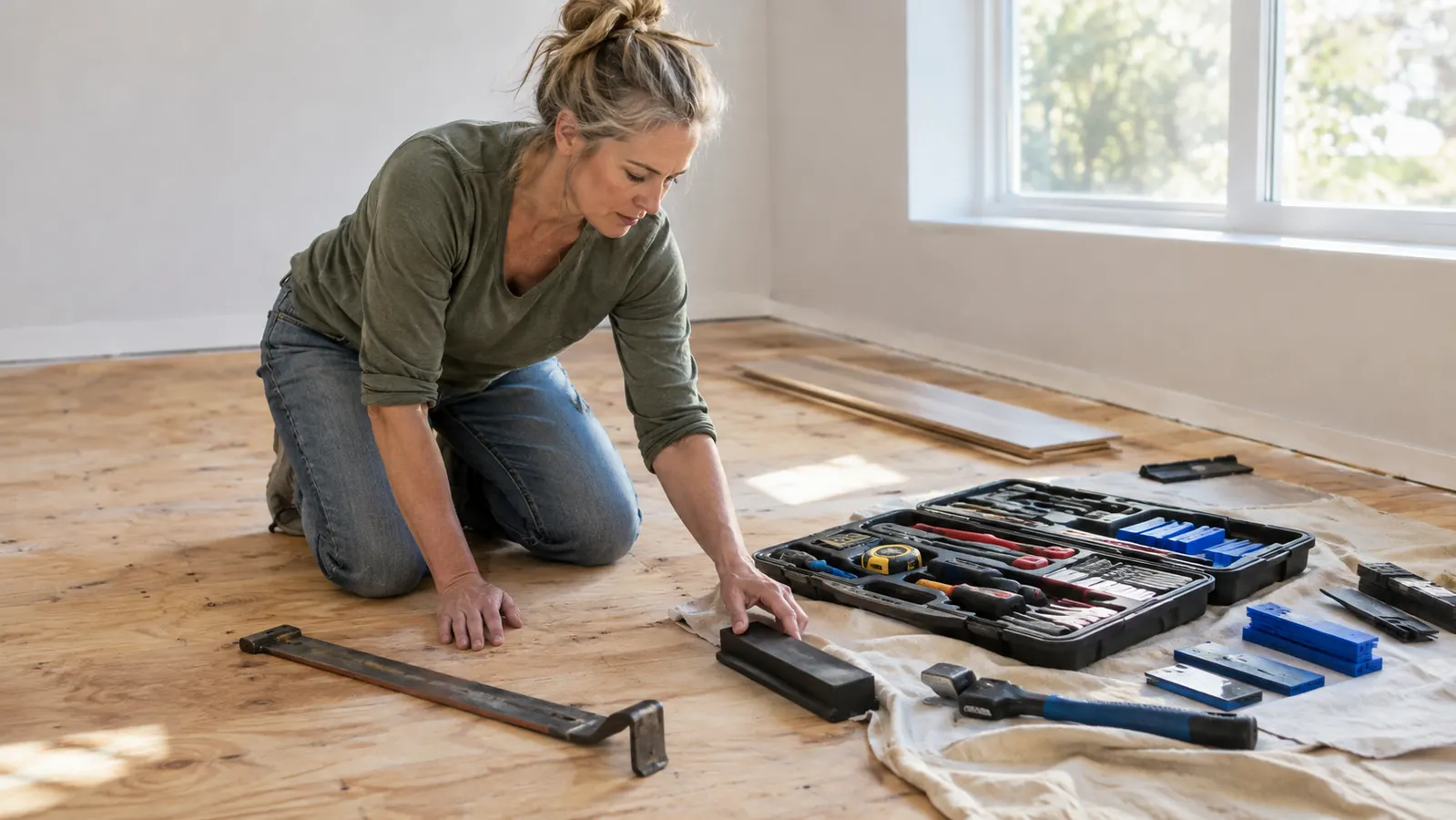
The first time I installed vinyl plank flooring, I used a scrap piece of 2x4 as a tapping block and a hammer I found in the garage. It worked, sort of. The plank edges dented, the 2x4 splintered, and I spent the next two evenings pulling out spacers that had wedged themselves under the baseboard. When I finally got around to the hallway in our 1962 ranch, I decided to do it properly and ordered the WORKPRO 65-piece flooring installation kit. Months later, after a hallway, a bedroom, and most of the living room, I have strong opinions about which pieces earn their place in the box and which ones I could have left behind.
This is not a review written after one afternoon of clicking planks together. This is what the WORKPRO kit looks like after real remodeling use, including a few mistakes I made along the way and the tools that saved me from repeating them.
The Quick Verdict
The WORKPRO flooring installation kit is the rare tool set where the whole is genuinely better than the sum of its parts. The tapping block, pull bar, and knee pads are excellent, the case is genuinely useful, and the only real weak point is the included utility knife. For a DIY homeowner installing LVP or laminate in one or two rooms, it is the kit I would buy again.
Amazon Check Today's Price →Skip the 2x4. Get the kit that made my hallway install actually pleasant.
I used the WORKPRO 65-piece flooring kit for three rooms of LVP in my own house. It has the tapping block, pull bar, spacers, and knee pads that turn a frustrating weekend into a straight, tight floor. Check today's price on Amazon and see if it fits your next room.
Amazon Check Today's Price on Amazon →How I've Used It
I bought the WORKPRO kit in early spring, right before I tackled the hallway that connects our three bedrooms. The house is a 1962 single-story ranch, about 1,600 square feet, and the hallway is roughly 30 feet long with four doorways. That means a lot of cuts, a lot of transitions, and a lot of chances for planks to shift out of square. I installed a 12mm LVP with an attached underlayment, which is forgiving in some ways and unforgiving in others.
My husband helped with the heavy lifting, moving the old furniture and hauling out the carpet, but the actual flooring work was mine. I worked on weekends, usually four to six hours at a time, kneeling on the subfloor with the WORKPRO knee pads under me. By the time I finished the hallway, the bedroom, and the living room, I had used every tool in the kit at least once, and a few of them dozens of times.
The kit comes in a hard plastic case with a handle, which matters more than you might think. I kept it on the folding work table in my garage workshop between sessions, and I never lost a single spacer. With my old setup, spacers disappeared into the void on a regular basis. The case also keeps the pull bar from rattling around loose in the car when I take the kit to help a friend, which I have done twice since buying it.
The biggest job the WORKPRO kit has done for me was the living room and hallway in our 1962 ranch, about 420 square feet of vinyl plank laid over the old subfloor once the carpet came out. I worked on it over three weekends, mostly by myself, with my husband carrying boxes in from the garage. The tapping block, the pull bar and the spacers came out of the case every single day of that job, and the rubber mallet barely left my hand.
What's Actually in the Box and What It's For
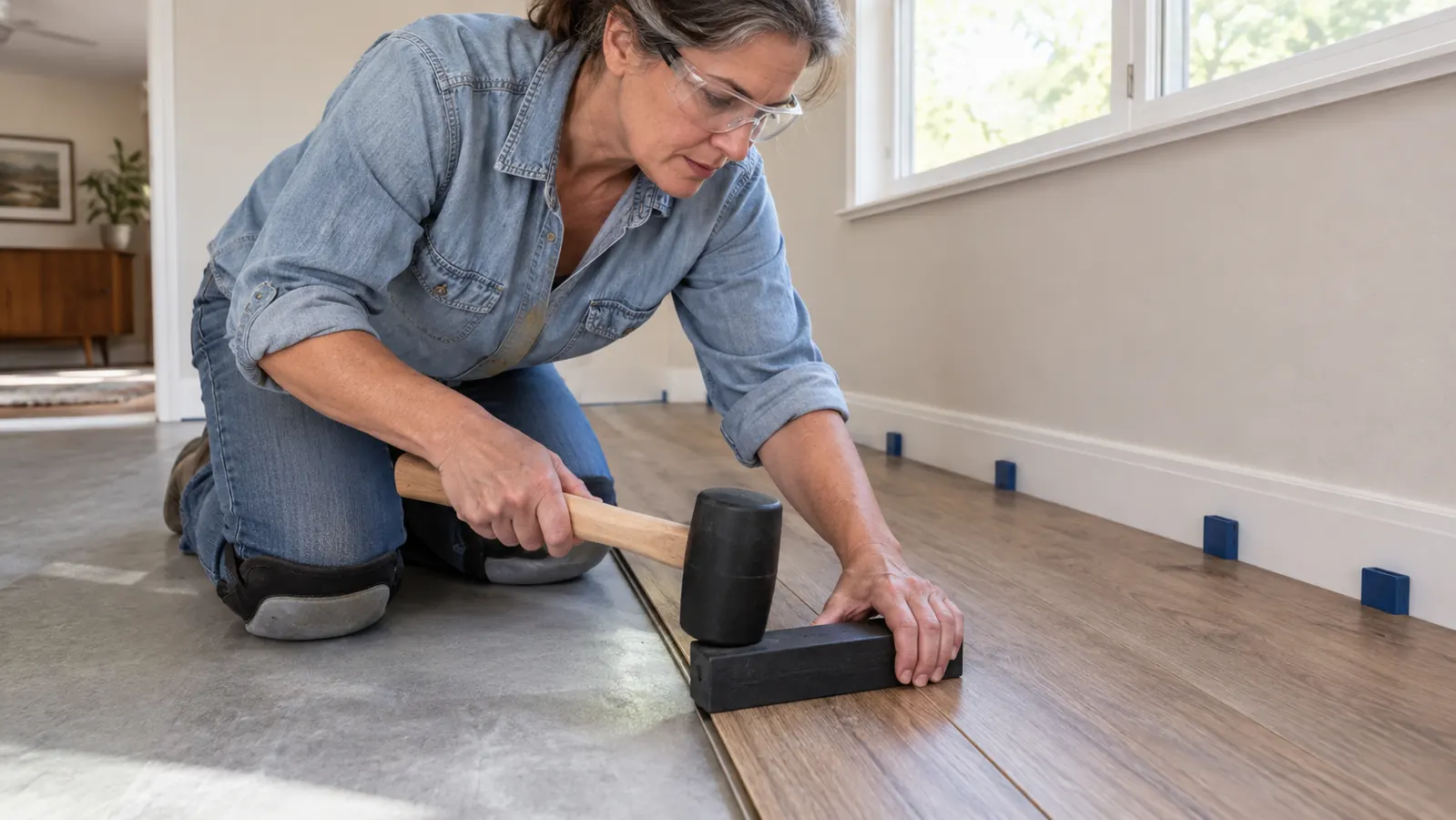
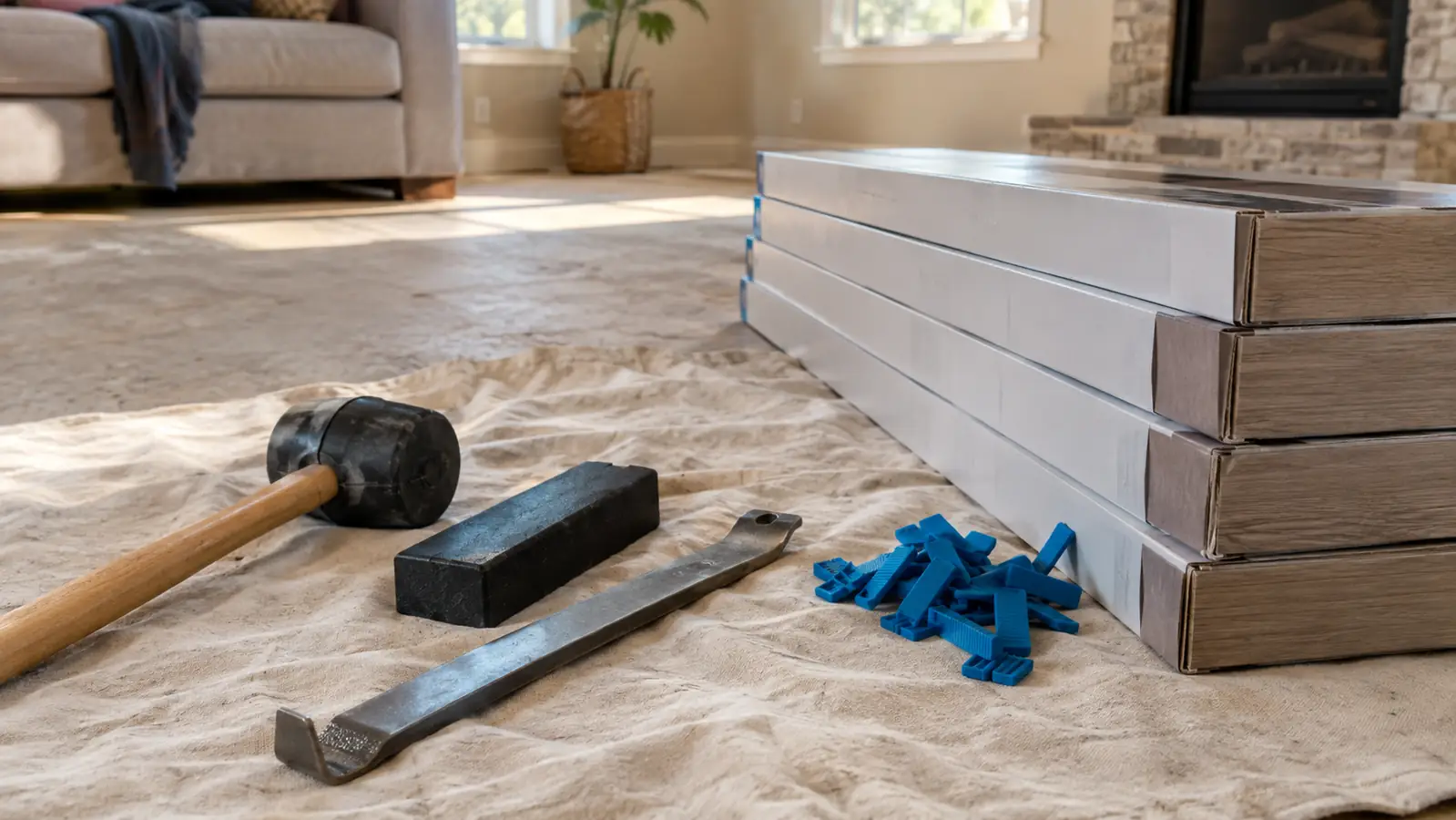
The WORKPRO kit includes 65 pieces, and the first thing I did was lay them all out on the garage floor to see what I was working with. The core tools are the ones you will use on every single row: a tapping block, a pull bar, a rubber mallet, and a set of spacers. The tapping block is the piece that surprised me most. It is wider and heavier than the cheap ones I have used before, which means it distributes the mallet strike across the plank edge instead of denting it. I hit it hard, probably harder than I needed to, and the planks stayed clean.
The pull bar is the tool I did not know I needed until I needed it. When you get to the last row against a wall, you cannot swing a tapping block, and the pull bar hooks under the plank edge and lets you pull it tight. On my hallway, the last row was against a wall that was not perfectly straight, so I had to rip several planks lengthwise. The pull bar made that final row look as clean as the first one, which is the difference between a floor that looks professional and one that looks like a DIY job.
The kit also includes a utility knife, a measuring tape, a carpenter's pencil, a chalk line, and a set of spacers in a few different thicknesses. The utility knife is the weakest tool in the box. The blade is fine for scoring laminate, but the handle is thin and uncomfortable for long cuts. I replaced it with my own knife halfway through the bedroom and never looked back. The measuring tape is short but perfectly adequate for flooring work, and the chalk line is a nice touch for anyone installing plank flooring on a diagonal.
The pull bar earned its place on the last row of every room. Against a wall there is no room to swing a mallet at the tapping block, so the pull bar hooks over the far end of the plank and you tap it back toward the joint. Without it, I would have been prying with a flat bar and probably chipping the edges. With it, the final rows locked together just as tightly as the ones in the middle of the room.
The spacers matter more than they look like they should. Vinyl and laminate both need an expansion gap around the edges of the room, and the WORKPRO spacers kept that gap even all the way along each wall. When the baseboard went back on, it covered the gap neatly, and the floor has not buckled or peaked anywhere through a full summer of Fresno heat.
How It Held Up Over Months of Use
I have a confession: I am hard on tools. I drop them, I step on them, and I leave them on the garage floor overnight. The WORKPRO kit has taken all of it. The rubber mallet head is still firmly attached after hundreds of strikes, the tapping block has no cracks, and the pull bar has not bent, which is the failure mode I was most worried about. The plastic case has a few scuffs from being tossed into the back of my car, but the latches still close tight and the handle has not snapped.
The knee pads are the surprise standout. I expected them to be an afterthought, the kind of thing you use once and shove back in the box. Instead, they became the reason I could do a second day of flooring at all. I am 56, and kneeling on plywood subfloor for four hours is not something my knees appreciate. The WORKPRO knee pads have a thick foam pad and a strap that stays put without cutting off circulation. I wore them for every session, and my knees were the least sore part of me at the end of each weekend.
The only thing that wore out was the utility knife blade, which is expected, and the included spare blades ran out faster than I would have liked. That is a minor complaint, but it is worth knowing if you plan to install more than one room. You will want a good utility knife of your own anyway, because the one in the kit is the weakest link.
The pull bar made that final row look as clean as the first one, which is the difference between a floor that looks professional and one that looks like a DIY job.
Where the WORKPRO Kit Saves You Money and Where It Doesn't
The biggest argument for buying a kit like this instead of assembling tools separately is the price of the individual pieces. A decent tapping block alone runs about the same as a fast-food lunch, a pull bar costs more, and a good pair of knee pads can cost as much as the entire WORKPRO kit. When I priced out buying the equivalent tools separately at the big box store, the total was more than double what the WORKPRO kit costs. That math is hard to argue with for a homeowner who does not already own flooring tools.
The counterargument is that you probably already own some of these things. You have a measuring tape. You have a pencil. You probably have a hammer, even if it is not a rubber mallet. If you already own a good utility knife and a decent tape measure, you are paying for duplicates. That is a real consideration, but the core flooring tools, the tapping block, the pull bar, and the spacers, are the ones you almost certainly do not own, and those are the ones that matter.
The other place the kit earns its keep is the case. I have watched friends show up to install flooring with a cardboard box full of loose tools, and I have watched them spend twenty minutes looking for the spacer they just set down. The WORKPRO case keeps everything in one place, and that alone saved me enough time over three rooms to justify the purchase.
If I could change one thing, it would be the carrying bag. The tools all fit, but after a few jobs the bag started to feel lighter duty than the tools inside it. It still keeps everything together, which is what matters, but I would not expect it to survive being tossed in a truck bed every day. For a homeowner who uses it a few times a year and stores it on a garage shelf, it has been fine.
Who This Is For
The WORKPRO flooring installation kit is for the DIY homeowner who is about to install vinyl plank, laminate, or engineered hardwood in one or two rooms and does not already own flooring tools. If you are standing in the flooring aisle at the big box store, looking at the price of a tapping block and a pull bar separately, this kit is the answer. It is also for the person who wants to do the job right the first time, because the pull bar and tapping block are the difference between a tight, professional-looking floor and one with gaps you will notice every time you walk across it.
It is also a great kit for a first-time installer. The tools are forgiving, the case keeps everything organized, and the included spacers make it easy to keep your expansion gap consistent. I learned on a 2x4 and a hammer, and I wish I had bought a kit like this before my first install. It would have saved me a lot of dented plank edges and a lot of frustration.
Who Should Skip It
If you are a professional installer who does flooring every day, you should skip the WORKPRO kit. You already own better versions of every tool in the box, and you will wear out the included utility knife in a week. The kit is aimed at the homeowner market, and it is priced and built for that level of use. A pro who needs a heavy-duty pull bar and a full-size mallet will want to buy those individually.
You should also skip it if you are installing a single small room, like a half bath or a closet, and you are confident you will never install flooring again. In that case, you can get away with a cheap tapping block and a pull bar borrowed from a friend. But if there is any chance you will do another room, or help a friend with theirs, the kit pays for itself in convenience alone.
What I Liked
- The tapping block is wide and heavy enough to seat planks without denting the edges
- The pull bar makes the last row against a wall look as clean as the first
- The knee pads are genuinely comfortable for full-day installs
- The hard case keeps all 65 pieces organized and nothing gets lost
- The price of the full kit is less than buying the core tools separately
Where It Falls Short
- The included utility knife has a thin, uncomfortable handle and is the weakest tool in the box
- The measuring tape is short and basic, fine for flooring but not a replacement for a good tape
- The spare blades run out quickly if you are cutting a lot of planks
- Not built for daily professional use
My hallway floor is still tight and gap-free months later. That is what this kit bought me.
The WORKPRO 65-piece flooring kit is the tool purchase I would make again without hesitation. If you have a room of LVP or laminate in your future, check today's price on Amazon and start your install with the right tools instead of a scrap 2x4.
Amazon Check Today's Price on Amazon →