
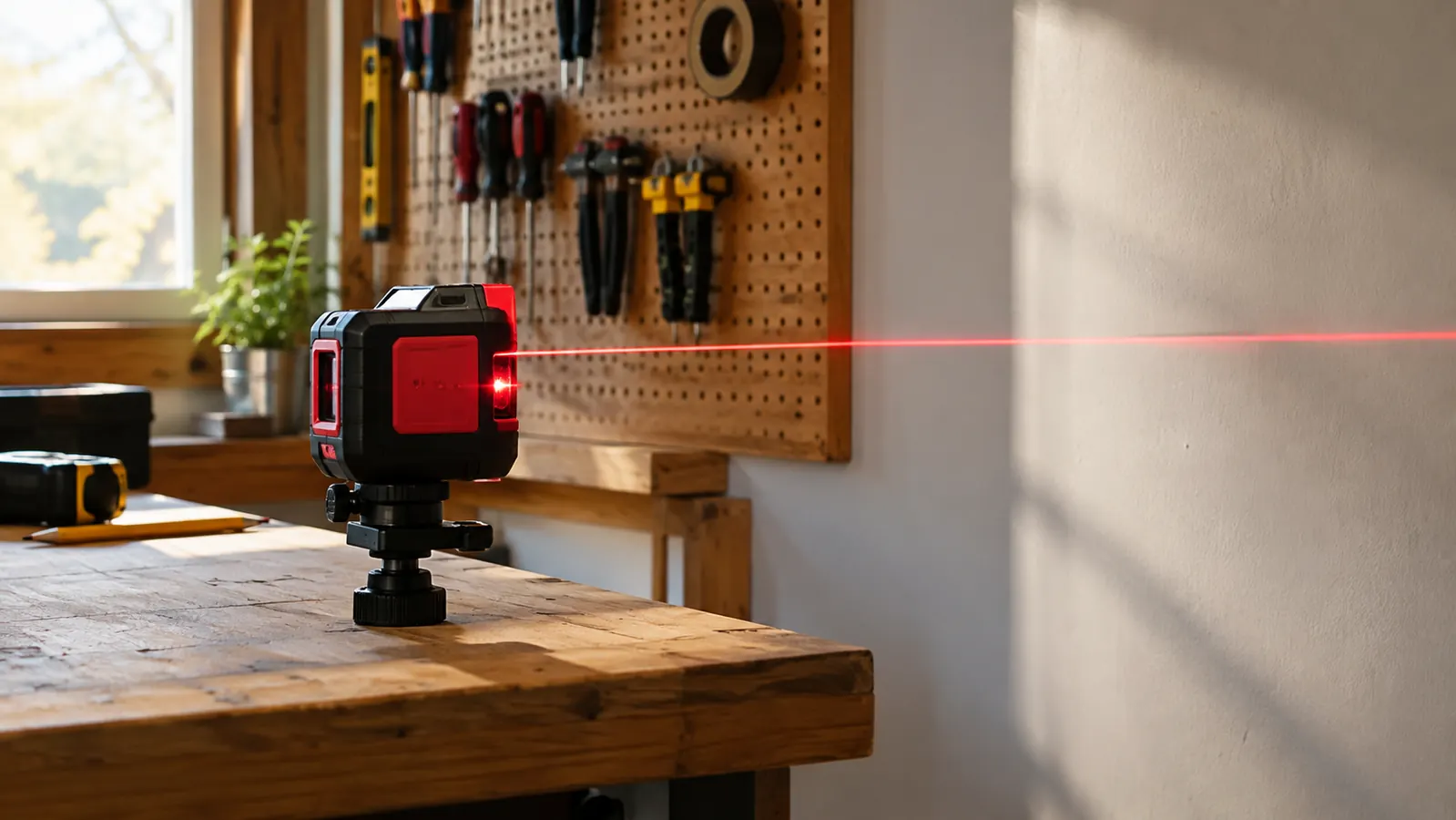
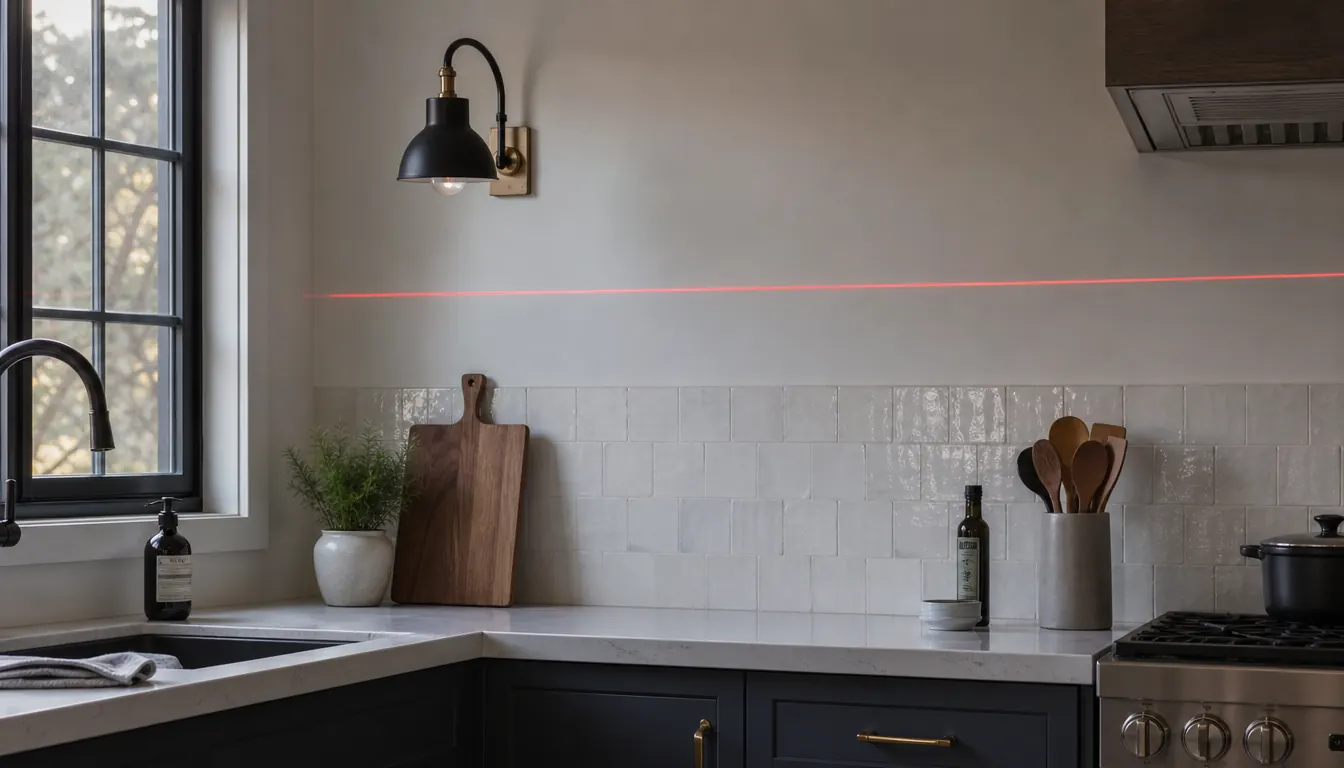
I bought the DEWALT DW088K in March of last year, about a week before I started tiling the backsplash in my kitchen. I had spent the previous weekend holding a four-foot level against the wall, drawing a pencil line, stepping back, squinting, and redrawing it. My husband kept asking why I was still on the first row of tile. The honest answer is that I was not sure my line was straight, and I did not want to find out at row seven.
Fourteen months later, the DW088K has been on more jobs than I can count: kitchen cabinets, bathroom tile, closet shelving, a hallway of wainscoting, and a set of floating shelves I am still slightly proud of. It has also frustrated me on a few jobs, and I think the things that frustrate me are the things nobody mentions in the product listing. This is the honest review I was looking for before I bought it.
The Quick Verdict
The DW088K is the right tool for most DIY wall and tile work: fast, accurate enough, and simple to set up. It is not the right tool for bright rooms, long distances, or anyone who wants a green beam. Know those limits and it earns its place on the pegboard.
Amazon Check Today's Price →The cross-line laser that has hung on my pegboard for 14 months
If you are tired of trusting a four-foot level and a pencil line, this is the tool I reach for first. It levels itself, projects a clean cross line, and has survived a year of weekend projects in my garage workshop.
Amazon Check Today's Price on Amazon →How I've Used It
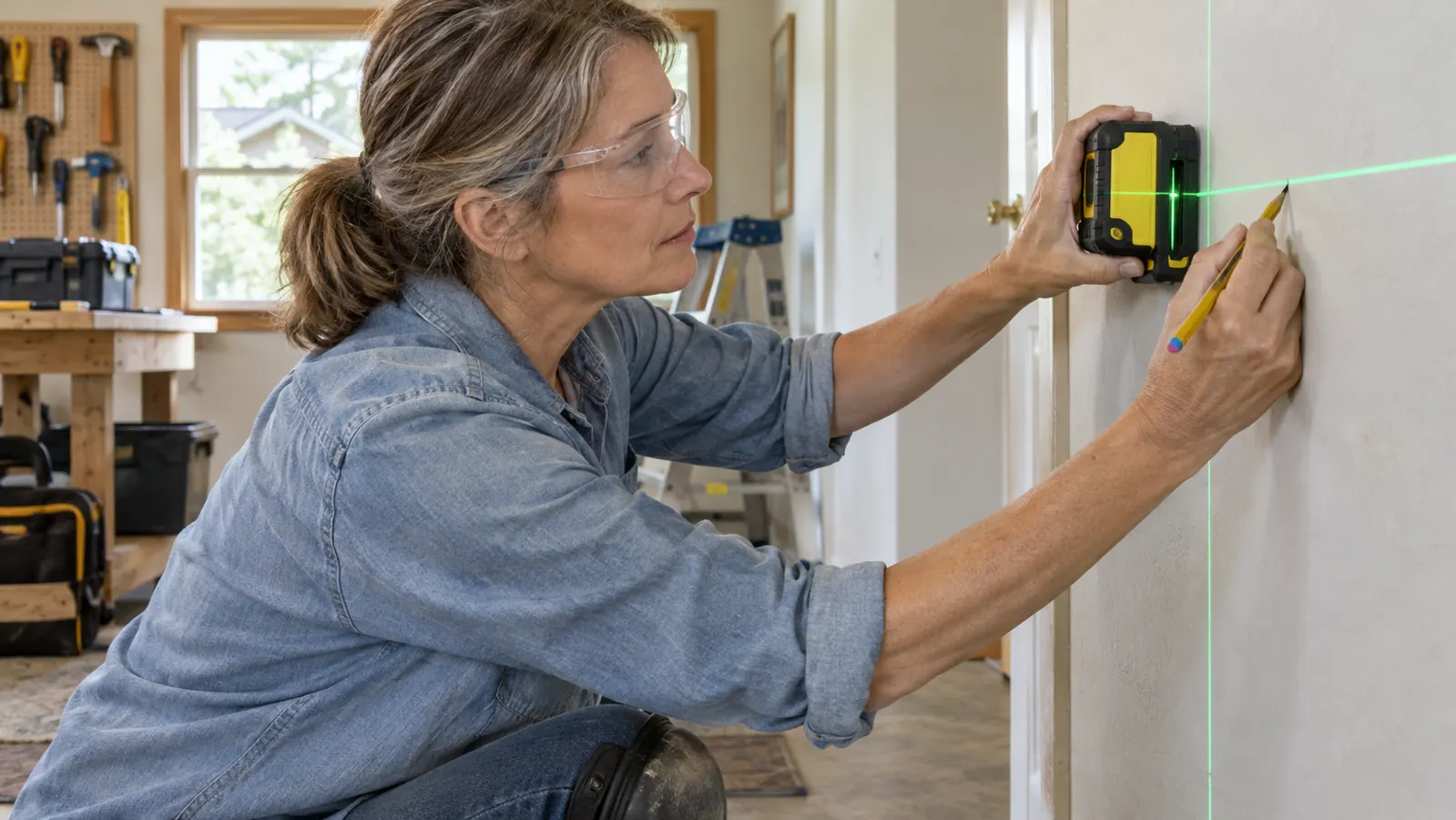
The DW088K is a self-leveling cross-line laser. It projects one horizontal line and one vertical line that cross at a right angle, and it levels itself across a range of about four degrees. You set it on a flat surface, or mount it on a tripod or wall bracket, switch it on, and wait a few seconds for it to stop flashing. When the line stops flashing, it is level.
In my house, that has meant the following jobs. The kitchen backsplash, where the horizontal line gave me a reference for every row of tile. The bathroom vanity, where the vertical line told me exactly where the center of the sink should land. A wall of shelving in the garage, where I used the vertical line to stack four brackets perfectly. And the wainscoting in the hallway, where the horizontal line saved me from a very visible mistake: the hallway floor is not level, and neither is the ceiling, and the only straight reference in the room was the laser.
The bathroom vanity job is the one I remember most clearly, because it was the first time I trusted the tool over my own eyes. The wall where the vanity was going had a window on one side and a door on the other, and neither was square to the floor. I spent a full evening measuring from the floor, marking the center, and second-guessing myself. The next morning I set the DW088K on a stool, let it level, and projected the vertical line onto the wall. The center mark I had measured was a half inch off the laser line. I re-measured to be sure, and the laser was right. That half inch would have meant a sink that was visibly off-center from the mirror above it. I have not measured a center mark with a tape since.
The unit runs on three AA batteries. I have replaced them twice in fourteen months, and the second set is still going. It has a mounting thread on the bottom that fits a standard camera tripod, which matters more than I expected. My folding work table is not level, my garage floor is not level, and my sawhorses are not level. The tripod is the difference between a tool that works and a tool that makes you fight it.
What Works Well
The first thing you notice is the speed. From the moment you switch it on, the laser takes maybe five seconds to self-level and stop flashing. That is faster than setting up a level, marking a line, checking the level again, and re-marking. For a weekend DIYer, the time savings are real, and they compound across a whole room.
The Saturday I hung the upper cabinets in the kitchen is the best example. I had measured the wall twice, marked the studs, and still ended up with the first cabinet a quarter inch low on the left side. With the old method, that meant loosening the screws, wedging a shim, and rechecking with the level, then doing the same for the next cabinet. Instead I set the DEWALT DW088K on the work table, let the horizontal line land where the bottoms of the cabinets should go, and worked from that line for all three boxes. The whole row went up in about two hours, and I only had to adjust one shim. The line did not move, so I did not have to re-mark. That is the real difference: the laser does not drift, so you stop redoing work.
The second thing is the accuracy. DEWALT rates the DW088K at plus or minus 1/8 inch at 30 feet. I have not measured it at 30 feet, because my longest wall is about 18 feet, but I have checked it against a six-foot level on every job and I have never caught it off. The line is crisp and thin, which matters when you are marking tile or trim. A fat, fuzzy line is useless for finish work. This one is not.
The third thing is the self-leveling range. The tool handles about four degrees of slope, which sounds small until you remember that most floors in a 1962 house are not off by four degrees. They are off by a quarter of an inch over eight feet, which is well within the range. The laser corrects for it, and you get a true horizontal line even when the surface under the tool is not level. That is the feature I did not know I needed until I owned it.
What I Liked
- Self-levels in about five seconds and holds the line without drifting
- Crisp, thin red line that is accurate enough for tile, trim, and cabinet work
- Standard 1/4-20 thread fits any camera tripod
- Three AA batteries last for months of weekend use
- Small and light enough to live on a pegboard without being in the way
Where It Falls Short
- Red beam washes out in bright rooms and direct sun
- No pulse mode, so it cannot work with a receiver at long range
- No tripod or wall mount in the box, and you will want both
- Manual mode locks the pendulum, so angled lines are back to hand leveling
- Battery door feels like the first thing that will break
What Nobody Tells You
Here is the part I did not find in the reviews before I bought it. The red beam is genuinely hard to see in bright light. In my garage, with the door open on a sunny afternoon, the line washes out completely. I have to close the door, or wait for the evening, or hold a piece of white paper behind the line to see it. Indoors, in a room with normal lighting, it is fine. In a sunlit room, it is a struggle.
The second thing nobody tells you is that the DW088K is a cross-line laser, not a multi-line laser. It projects one horizontal and one vertical line. It does not project a plumb dot, it does not project a second vertical line, and it does not project a 360-degree horizontal line around the room. For most of my projects, the cross is enough. For the hallway wainscoting, I wanted a line that wrapped around the whole room, and I had to move the laser and re-level it at each wall. That is not a flaw in the tool. It is a limitation of the category, and it is worth knowing before you buy.
I found out the hard way on the floating shelves in the living room. My first attempt at those shelves used a string line and a torpedo level, because I thought a laser was overkill for three small shelves. I tied the string tight, marked both ends, and cut the shelf brackets to what I thought was a perfect line. When I set the first shelf on the brackets, it looked fine from the doorway and obviously crooked from the couch. The string had sagged a quarter inch in the middle, and the torpedo level told me the brackets were true when the wall itself was not. I pulled everything down, set up the DEWALT DW088K on a tripod, and projected the vertical line to find the studs and the horizontal line to set the brackets. The shelves have been straight for eleven months. I still think about that wasted Saturday every time I reach for the laser.
The third thing is the tripod situation. The DW088K has a standard 1/4-20 thread on the bottom, which fits a camera tripod, but the kit does not include a tripod or a wall mount. You will need to buy one, or you will be balancing the tool on stacks of shims, which I have done and do not recommend. The worst was the afternoon I balanced it on a stack of paint cans to mark the closet rod height. The laser was level when I walked away and a quarter inch off when I came back, because the cans settled. A tripod costs less than the time I wasted re-marking that closet. The laser is not heavy, but it is not stable on a folded towel either.
The red beam is genuinely hard to see in bright light. In my garage, with the door open on a sunny afternoon, the line washes out completely.
Where It Falls Short
The brightness is the biggest shortfall, and it is the reason I have a second laser on my wish list. For indoor work in normal light, the DW088K is plenty. For anything near a window, or in a room with a skylight, or on a sunny day in the garage, the red line fades. I have learned to work around it, but I have also learned that a green beam laser would not have that problem. Green is easier for the human eye to see, which is why the green beam models cost more.
The day it really bit me was last August, when I was marking the fence line in the backyard. I clamped the DW088K to a sawhorse, aimed the vertical line down the run of posts, and walked to the far end to check the alignment. The line was invisible past about twelve feet in the afternoon sun. I tried holding a piece of white cardboard behind the posts, which helped for one post at a time, but it was slow and awkward. I ended up doing the layout in two passes, once in the morning shade and once after dinner. The job got done, but it took twice as long as it should have. If you are going to use a laser outside, budget for a green beam model or plan your work around the sun. Neither is a fun lesson to learn on the job.
The second shortfall is the lack of a pulse mode. Some lasers have a pulse mode that lets them work with a dedicated receiver, which extends the range to hundreds of feet. The DW088K does not have that. For a DIY homeowner, that is probably fine. For anyone planning to use it on a large construction site, it is a real limitation. If you think you might ever need receiver range, buy that model now, because upgrading later means owning two lasers.
The third shortfall is the manual mode. The DW088K has a manual mode that lets you lock the pendulum and project a line at any angle, which sounds useful until you try it. The line stops being self-leveling, and you are back to holding a level and a laser at the same time. I have used manual mode exactly once, to project a sloped line for a shelf in the garage, and I would not call it a pleasure.
How It Compares to What I Expected
I expected a tool that would make my lines straighter. I did not expect a tool that would change how I plan a project. Before the DW088K, I would measure, mark, check, and re-mark. Now I set up the laser, let it level, and mark once. The confidence is the real upgrade. I trust the line, so I stop second-guessing myself, and I stop redoing work.
I also expected the DW088K to be a one-trick pony. It is not. I have used it for tile, wainscoting, shelving, cabinet hardware, and even a fence line in the backyard, where I clamped it to a sawhorse and used the vertical line to keep posts straight. It is more versatile than I expected, and the versatility is what makes it worth the space on my pegboard.
The one thing I did not expect, and still have not fully solved, is the battery door. It is a small plastic latch on the side, and it feels like the kind of thing that will break in year three. It has not broken yet, but I treat it gently, and I mention it because nobody else does. I have owned tools long enough to know which parts fail first, and this latch is the one I watch.
Who This Is For
The DW088K is for the DIY homeowner who is tired of holding a level against a wall and drawing a line that is not quite straight. It is for the person tiling a backsplash, hanging cabinets, installing wainscoting, or building shelving. It is for the person who wants a line they can trust, without paying green beam prices. If that sounds like you, this is the tool.
Who Should Skip It
Skip the DW088K if you do most of your work outdoors, or in bright rooms, or on large commercial jobs. The red beam will frustrate you. Skip it if you need a plumb dot, or a 360-degree line, or a receiver-compatible pulse mode. Those are different tools, and no amount of wishing will make the DW088K into one of them. And if you are the kind of person who loses patience with a tool that needs a tripod, budget for the tripod at the same time you budget for the laser.
The honest bottom line after 14 months of weekend projects
The DW088K is not perfect, but it is the tool I reach for first, and the one I would buy again. If you want a straight line you can trust without spending for features you will not use, this is it.
Amazon Check Today's Price on Amazon →